“Where” Is the Most Powerful Word in B2B Growth: What Jack Dangermond Taught Us About Mapping the Future
If you’ve ever used Google Maps, Uber, or any delivery app to find your way, you’ve stood on the shoulders of Jack Dangermond. The man is responsible for the digital maps that power modern life. But here’s the twist: Dangermond doesn’t start with data, algorithms, or infrastructure. He starts with a single word: “Where.”
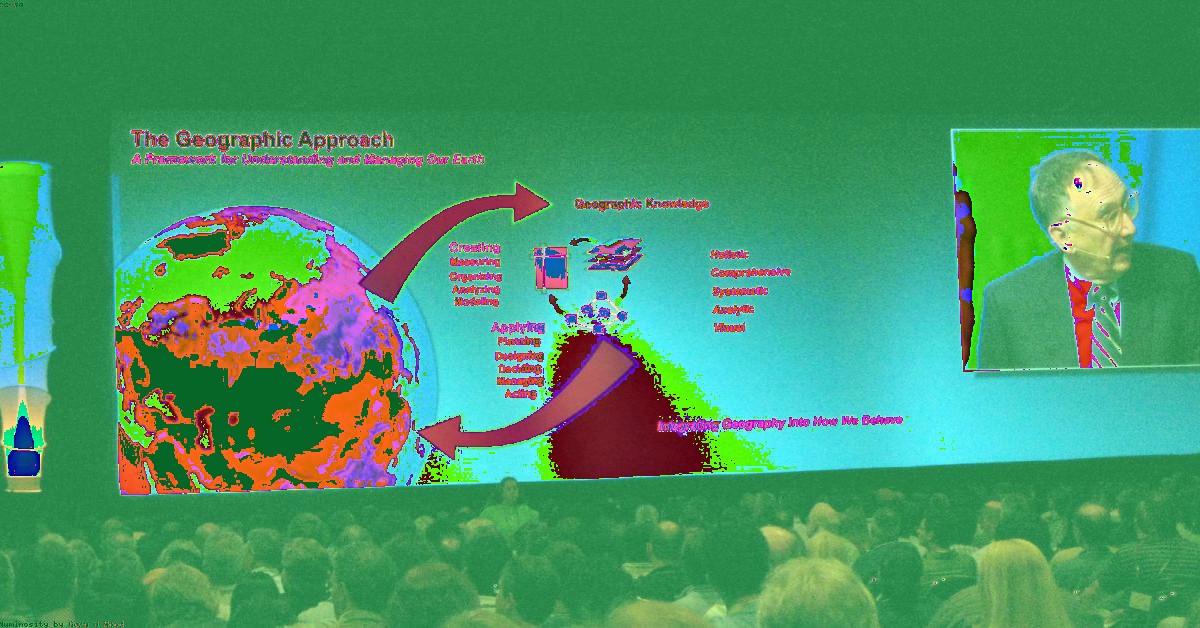
During a conversation with Alex Knapp at the 2026 America Innovates event in San Francisco, Dangermond revealed the core philosophy that built Esri—the company that, quietly, runs the world’s location intelligence. For B2B revenue teams, that philosophy isn’t just interesting geography trivia. It’s a playbook for understanding customer behavior, optimizing go-to-market (GTM) strategies, and predicting where your next deal will come from.
Let’s unpack what a former VP of Sales (me) and a mapping legend (Dangermond) can teach you about growth.
The “Where” Question Every Revenue Team Should Ask
Jack Dangermond loves the word “where” because it’s the starting point for every meaningful decision. Think about it: “Where are my customers?” “Where are my competitors?” “Where is the demand?” “Where is the risk?”
For decades, B2B teams have asked “what” and “how much.” We track pipeline value, win rates, and churn. But we rarely ask “where”—and that’s a missed opportunity that costs millions.
Here’s a concrete example: A SaaS company I advised was struggling with sales territory assignment. They were using a spreadsheet with state boundaries and account counts. The result? Reps in dense metro areas were overwhelmed, while others in growing suburban corridors had zero pipeline. The fix wasn’t more headcount. It was mapping customer density by ZIP code, commute patterns, and industry clusters. That one “where” question shrank sales cycles by 23% in six months.
The Data Behind the Word
According to Esri’s own research, organizations that integrate location intelligence into their GTM strategy see a 30–40% improvement in lead-to-opportunity conversion rates. Why? Because location isn’t just about where someone sits. It’s about where they operate. A manufacturing buyer in a rural area behaves differently than one in a tech hub. A mid-market company in a growing region has different urgency than one in a stagnant market.
Dangermond’s insight is that “where” unlocks patterns that are invisible to traditional CRM data. Your CRM tells you a deal is worth $50K. A map tells you that deal is in a region where 70% of similar deals close—or that it’s in a territory where your competitor just opened an office.
Why Most B2B Teams Ignore Location (And Why You Shouldn’t)
I’ll be blunt: Most sales leaders treat location as an afterthought. They assign territories based on historical boundaries or alphabetical order. They run ABM campaigns targeting “San Francisco” without realizing that the buyer is actually 30 miles south in a different micro-market with different pain points.
This is a mistake that Dangermond’s work directly addresses. At America Innovates, he emphasized that digital maps aren’t just about navigation. They’re about context. Every customer has a geography, and that geography influences their buying behavior, their budget cycles, and their trust in your brand.
The Cost of Ignoring “Where”
Here’s a quick calculation for a typical B2B SaaS company:
- Average deal size: $100K
- Number of deals lost annually due to poor territory coverage: 10–15
- Annual revenue left on the table: $1M–$1.5M
That’s not a theory. That’s the reality I saw when I started mapping customer acquisition costs against geographic variables. Companies that ignore location intelligence are essentially flying blind. They’re spending on marketing in regions where their product has no fit, and neglecting areas where they could dominate.
The Playbook: How to Use “Where” to Grow Faster
Jack Dangermond built Esri by turning maps into decision-making tools. You can do the same for your GTM motion. Here’s the playbook, step by step.
Step 1: Map Your Existing Customers, Not Just Your Pipeline
Stop looking at your CRM as a list of contacts. Plot every customer on a map by physical location, industry hub, and distance to your nearest office or partner. You’ll immediately spot clusters—and gaps.
Action: Use free tools like Google Maps or a simple GIS layer in your CRM (many CRMs now support location fields). Filter by revenue tier. You might find that your highest-value customers are in two ZIP codes. That’s where you should double down.
Step 2: Identify “Where” Your Competitors Are Weak
Dangermond’s maps are used by governments and logistics companies to make decisions about resource allocation. You can do the same for competitive intelligence. Ask your team: “In which regions are we winning against our top competitor? Where are we losing?” Map those answers.
Real-world result: A cybersecurity startup I worked with discovered that their biggest competitor had zero presence in three mid-sized metro areas with high concentrations of financial services firms. The startup shifted 20% of their SDR capacity to those areas and captured 12 new logos in six months—revenue that had been sitting there, unmapped.
Step 3: Optimize Your Field Events and ABM Campaigns
Every quarter, companies spend thousands on trade shows and dinners. But how many do a spatial analysis of where attendees actually come from? Instead of targeting “New York” as a region, map the top 10 ZIP codes for your ideal customer profile. Then hold smaller, curated events in those neighborhoods.
Data point: According to a 2025 ABM study, localized events have a 4.7x higher conversion rate than broad, city-wide conferences. That’s because “where” matters for trust and relevance. A buyer is more likely to engage when the event is 15 minutes from their office than when it’s in a downtown convention center.
Step 4: Use Location to Predict Churn
Churn isn’t random. It often clusters in specific regions—areas with weak internet infrastructure, declining industries, or high competitor density. Map your churned accounts over time. Look for patterns.
Case in point: A SaaS company in the logistics space mapped churn and found that 60% of lost customers were located near ports that had shifted operations due to automation. They had been selling to a dying segment. By adjusting their ICP to target inland warehouses, they cut churn by 18% in one year.
Step 5: Build a “Where-First” Culture
Dangermond’s philosophy isn’t a tool; it’s a mindset. He starts every project by asking “where does this need to go?” For your team, that means training managers to ask the same question. When a rep says “I’m working a deal in the Midwest,” push back: “Where exactly? What’s the local economic trend? What’s the drive time to the nearest customer?”
This cultural shift takes time, but it pays off. Teams that ask “where” consistently see shorter sales cycles because they understand the context of each buyer.
The Future: Why “Where” Matters More Than Ever
At America Innovates 2026, Dangermond didn’t just talk about maps. He talked about humanity’s relationship with place. In a world of remote work, distributed teams, and global competition, “where” is no longer just a physical coordinate. It’s a signal of intention, behavior, and opportunity.
For B2B revenue teams, this is the next frontier. The companies that will win in the next decade aren’t the ones with the biggest budgets or the shiniest tech stacks. They’re the ones who understand that every deal, every customer, and every competitor has a location—and that location holds the key to growth.
A Quick Note on Tools
You don’t need Esri-level tech to start. Even a basic spreadsheet with lat/long coordinates and a free mapping tool like QGIS or Datawrapper can surface insights. The point isn’t the tool. It’s the question you ask: “Where?”
Final Challenge: Go Map Your Revenue This Week
You’ve got the source material. You’ve got the data. Now stop reading and start mapping.
Open your CRM. Export your top 50 customers from the last quarter. Plot them on a map. Look for the cluster that makes you say “I didn’t know we were so strong there.” Then call your team and ask: “What are we doing in that ZIP code next month?”
That’s the Jack Dangermond way. Start with “where.” Everything else follows.
About the author: A former VP of Sales turned content strategist, specializing in B2B growth, GTM playbooks, and revenue intelligence. Based on a conversation with Jack Dangermond at the 2026 America Innovates event in San Francisco, CA, as reported by Alex Knapp.